

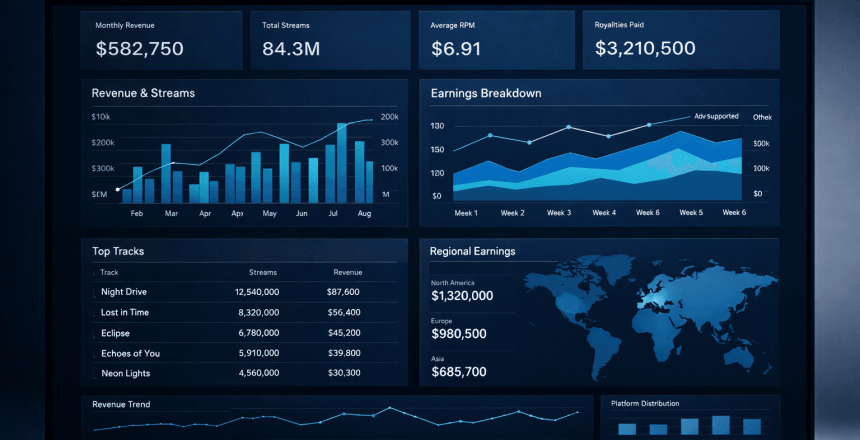
The independent music economy has never been more accessible, but it has also never been more misunderstood. Artists can release music globally in minutes, track performance in real time, and monitor audience growth across platforms. What remains largely invisible to most is the infrastructure that determines how and where revenue is actually collected.
Every piece of music generates multiple forms of income across separate systems that do not automatically communicate with one another. These systems do not register ownership on your behalf, nor do they reconcile missing or incomplete data. As a result, a significant portion of independent artist revenue is not lost because it does not exist, but because it is never properly captured.
This is the foundation of how music business royalties operate. Without a clear understanding of how these systems function together, it is nearly impossible to collect income at scale.
How Music Business Royalties Actually Work
At the core of the royalty system are two distinct copyrights: the sound recording and the underlying composition. The sound recording refers to the master, while the composition refers to the songwriting itself. Each generates separate income streams and is governed by different collection mechanisms.
This distinction is critical. Most independent artists engage only with distribution platforms, which collect revenue tied to the sound recording. However, a parallel layer of music business royalties exists on the publishing side, and it requires separate registration and management.
The gap between these two systems is where a large percentage of uncollected income originates.
Streaming Revenue in Context
Streaming platforms such as Spotify and Apple Music generate revenue tied to the master recording, which is typically collected through a distributor. While this is often the most visible source of income, it represents only one portion of the broader royalty ecosystem.
The same streams also generate publishing income through performance and mechanical royalties. These are not collected by distributors and instead flow through separate organizations. Without proper registration, those earnings remain unclaimed, regardless of streaming volume.
Understanding this distinction is essential to accurately evaluating music business royalties.
Streaming Is Only One Layer
Most artists focus on streaming platforms because they are visible.
Spotify, Apple Music, Youtube Music, Tidal, and other DSPs pay out based on usage of the master recording. Your distributor collects that income and reports it to you.
That is one part of the system.
What many artists do not realize is that the same stream also generates publishing royalties. Those are not collected by your distributor. They flow through separate channels tied to the composition.
If you are only set up on the distribution side, you are only collecting part of what your music generates.
Digital Performance Royalties and SoundExchange
A separate category of royalties is generated when music is played on non-interactive digital platforms such as Pandora radio, SiriusXM, and webcasters. These uses fall outside traditional streaming and are administered by SoundExchange.
SoundExchange distributes revenue directly to the recording owner, the featured artist, and non-featured performers. This system operates independently of both distributors and performing rights organizations. As such, registration is required to receive payment.
For many independent artists, this represents an overlooked component of music business royalties.
Performance and Mechanical Royalty Collection
Performance royalties are generated when a composition is publicly performed and are collected by organizations such as ASCAP and BMI. Mechanical royalties, particularly those derived from digital streaming in the United States, are administered by The Mechanical Licensing Collective.
A common misconception is that these systems are automatically handled through distribution. In reality, they operate independently and require direct registration.
Without participation in both systems, the collection of music business royalties remains incomplete.
Publishing Administration and Scale
At an early stage, artists may choose to manage publishing responsibilities independently. This includes registering compositions, maintaining accurate ownership splits, and tracking income across multiple sources.
As catalog size increases, the complexity of managing music business royalties grows accordingly. Additional collaborators, international usage, and variations in metadata introduce a higher risk of inconsistency.
Publishing administration exists to address these challenges by managing registration, synchronization of data, and global collection. At scale, accuracy in these areas directly impacts total revenue.
Sync Licensing and Rights Clarity
Sync licensing introduces another layer of revenue, placing music in film, television, advertising, and interactive media. Micro sync extends this into digital environments where creators license music for short-form content.
In both cases, the ability to secure placements depends on clear and verifiable ownership. Supervisors and licensing platforms require immediate confirmation of rights across both the master and the composition.
Inconsistent or incomplete data can prevent otherwise viable opportunities from progressing, regardless of the quality of the music itself. Within the broader system of music business royalties, clarity of ownership is often the determining factor.
Infrastructure and Revenue Integrity
The effectiveness of a royalty system is determined less by visibility and more by structure. Registration with a performing rights organization, the Mechanical Licensing Collective, and SoundExchange represents the minimum baseline for participation.
Equally important is the alignment of metadata across all platforms, including distributor records, publishing registrations, and ownership documentation. Discrepancies between these systems are a primary cause of lost revenue.
In practice, most issues related to music business royalties are structural rather than promotional.
When a Royalty Audit Becomes Necessary
As a catalog expands, inconsistencies become more difficult to identify through surface-level reporting. Discrepancies between expected and actual revenue, particularly across multiple platforms, often indicate underlying issues in registration or data alignment.
A royalty audit provides a comprehensive review of these systems, identifying gaps that may not be immediately visible. In many cases, these gaps have accumulated gradually over time.
Within the context of music business royalties, audits are not corrective measures alone. They are part of maintaining long-term revenue integrity.
Final Perspective
The independent music landscape places significant emphasis on distribution, marketing, and audience growth. While these factors are essential, they do not determine whether revenue is ultimately collected.
Music business royalties are governed by a fragmented system that requires deliberate structure and ongoing management. Artists who understand and organize these systems effectively are positioned not only to generate income, but to retain it.
In an environment where access is widespread, the defining advantage is no longer